
How to Explore Anime Maps Without Spoilers
An anime map is most useful when it answers a question you already have: where the characters are, which places belong to the same region, or how the current journey connects to an earlier stop. For a first watch, set a story cutoff before exploring. Search for familiar places individually and leave unknown names for later.
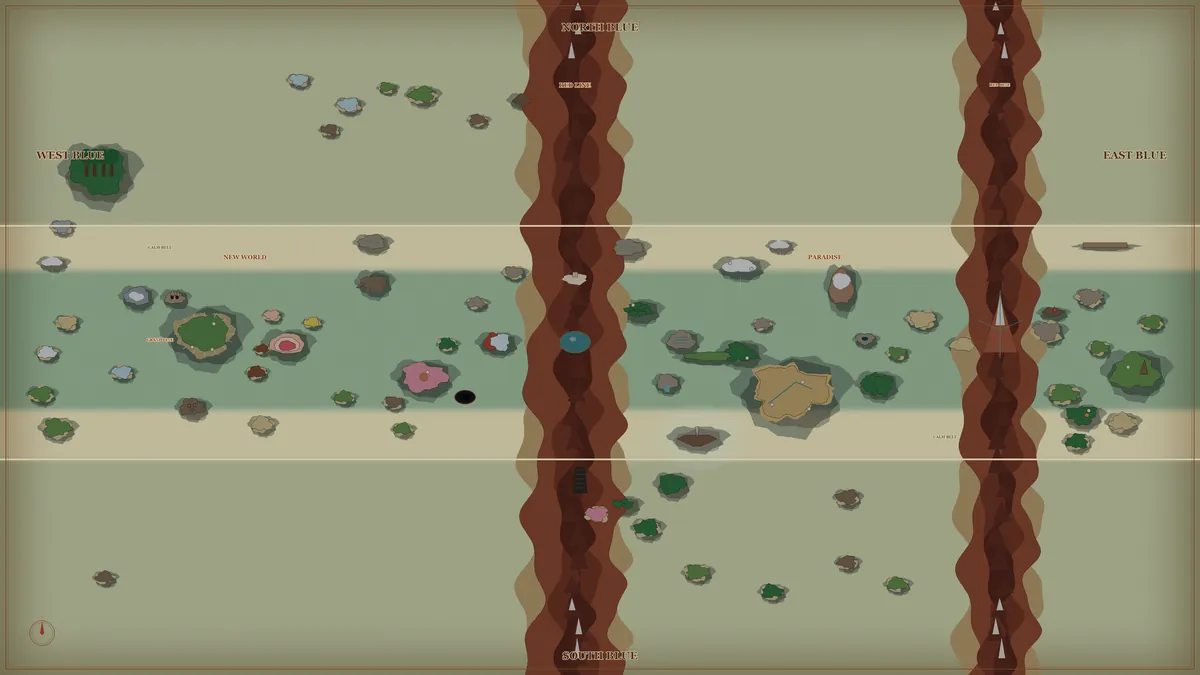
Set your story cutoff before opening the atlas
Write down the last episode you finished and the place where the current arc is happening. If you also read the manga, decide which version you want the map to support. A place introduced in the manga may still be a reveal for someone following only the anime.
This is a browsing habit, not a promise that the map hides future information. A complete map can reveal an unfamiliar island through its label alone. If you want to avoid even location names, postpone the full atlas until you finish the arc.
Read regions before drawing a route
First identify the level of the map: a whole world, a region, an island, or a town. Two markers close together on a world map may represent very different distances from two buildings close together on a city map. A reference atlas is not automatically a travel timetable or a scale drawing.
On the One Piece map, start by finding a place you recognize and reading its regional context. Look at the broad divisions before following smaller landmarks. Avoid assuming that the shortest line between two labels is the route taken in the story.
Look up one place instead of browsing every marker
Use the map’s search or index to locate the exact name mentioned in the episode. Read that entry, then return to the scene. Opening every nearby marker can expose later destinations, characters or images you were not trying to find.
When a title offers several maps or plates, choose the one that matches the question. A town view helps with streets and buildings; a world view helps with regions. Zooming a world map cannot supply street detail that the underlying plate does not contain.
Keep a small journey log
Separate what the episode showed from what you inferred. “The group left this port” is an observation. “They must reach that island next” is a prediction. Keeping those apart makes the map useful without turning a guess into a spoiler you accidentally share.
- Series and version: anime, manga or adaptation.
- Last episode finished: your personal cutoff.
- Place named on screen: the wording you heard.
- Region and previous stop: only what you already know.
- Open question: something to revisit after the next episode.
Match the map to the episode you are watching
Confirm the series and season before looking up a location, especially when a franchise has remakes, films or similarly named installments. Watchanimee provides episode guides and licensed viewing links through watch anime online. Check the destination service for regional availability and language options.
A streaming catalog answers where an episode can be watched; a map answers where an event happens inside the fictional world. Use the two for those separate questions, rather than treating a map marker as evidence of an episode’s availability or viewing order.
When should you stop exploring?
If a marker name feels unfamiliar: leave its description unopened and return after the story introduces it. Searching for the name on a fan wiki can reveal more than the map would.
If the geography seems inconsistent: check which map or adaptation you opened before assuming the story has a mistake. Keep your question in the journey log. Continue through the TV maps or the full map collection when you are ready to explore another world.